
Interview with MACC Fellow and artist Josie Hoffman
George Morrison’s Turning the Feather Around.’ A mural for the Indian has been a staple feature of the Minneapolis American Indian Center (MAIC) for over 50 years. As such, it has been a work of great care to make sure the façade could be restored and repositioned to continue to be highlighted as part of the landscape of MAIC.
Two Rivers Gallery got to sit down with Josie Hoffman (she/they) (Grand Portage Anishinaabe), one of the fellows selected to work with the Midwest Art Conservation Center (MACC) on the conservation of George Morrison’s Turning the Feather Around.’ A mural for the Indian, to talk more about what this project means for MAIC and the urban Indigenous community in the Twin Cities, and why it’s so important we work with other Indigenous people on this project; and learn more about them, the experience she had on the project with MACC, other projects she has accomplished, their own family history with George, and her own art practice.
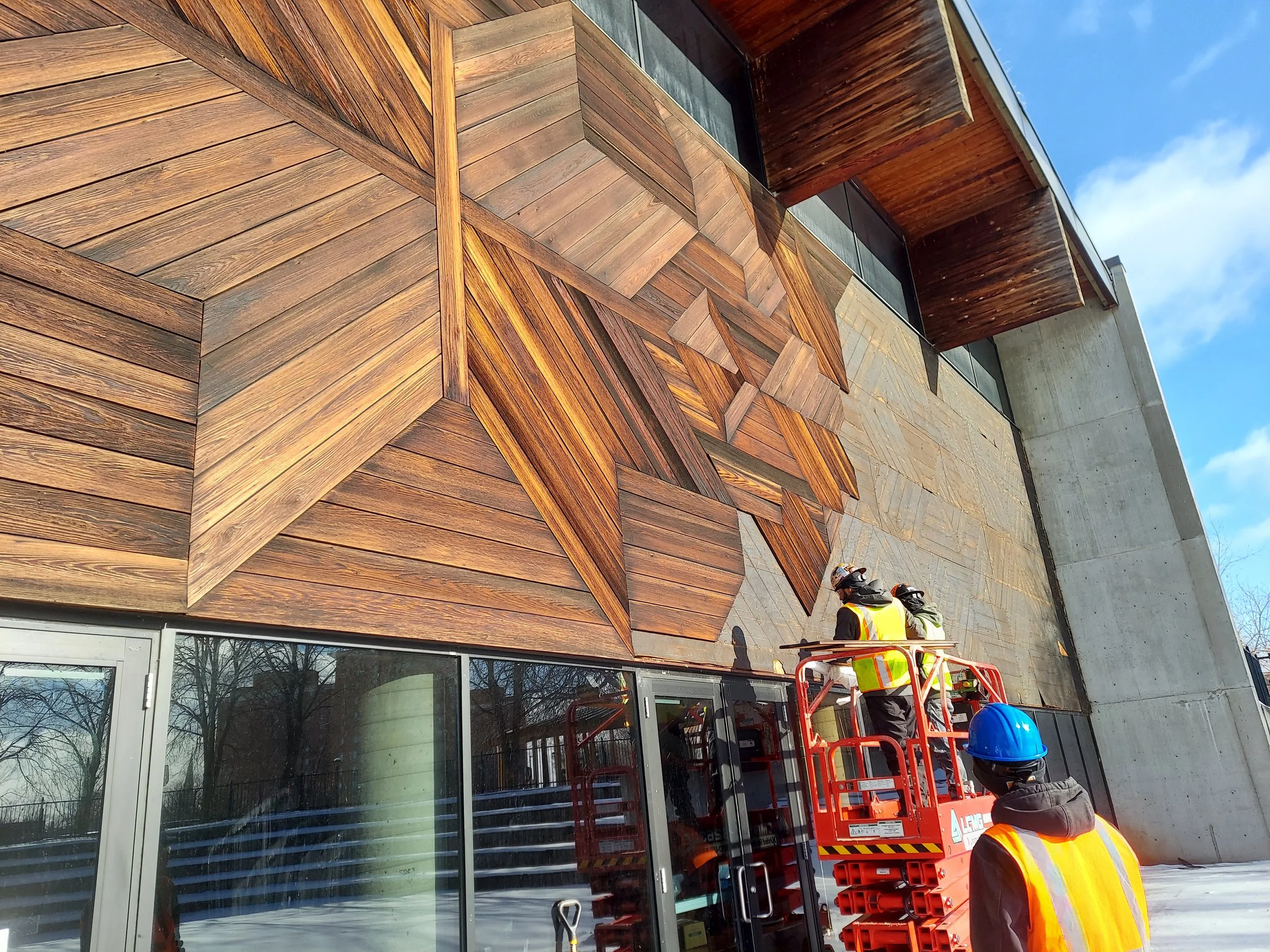
Beginning of de-installation by the MACC fellows. Photo provided by Megan Randall
“I’m an artist,” Josie starts, “I graduated school from Minneapolis College of Art and Design in 2020 and [I’ve] been doing a variety of projects. From teaching aerial arts and working with the Native Youth Arts Collective at Little Earth, and doing my own art projects. Got into this conservation project in 2022. And also just finished a curatorial project with Minneapolis Institute of Art (MIA)”
Tell us a little bit about that project:
“I curated a case in the Native galleries that actually has two George Morrisons in it. The theme is about dance and kinetic movement and how that connects to our community and the land around us. And so I have a selected pieces; there is a bandolier bag and some leggings and then I’ve got two George Morrisons in there and then a Wendy Redstar dress and Alex Janvier, he’s a Diné artist.” She explains, recalling the exhibit, “If you want to check that out its going to be up for a year.”
To learn more about Josie’s thoughts behind the installation, check out this interview with MIA news.
Josie has found inspiration before in movement and dance. They site an interest in the subject when talking about their work she completed when finishing school at Minneapolis College of Art and Design (MCAD). She talks about her transition in and out of different mediums throughout her career. Saying, “I was a fine arts student and got my minor as a teaching artist. I’ve always done a lot of mixed media stuff. I focused a lot on sculpture and mixed media 2D things. I do a lot of materials; in school I was really into working, especially when it came to sculpture, with welding and doing plaster and ceramics stuff. Now that I’m graduated, I’ve been focusing on my textiles and getting better at sewing and beading. I’m also a dancer so I also want to make stuff.”
What was your final school project?
“So, because I graduated in 2021 we didn’t actually get a real show, but I had the whole thing planned. It was the study in movement that I was doing because I grew up a powwow dancer and I also have been doing aerial arts.” Josie also teaches aerial arts in multiple locations around Minneapolis. “So aerial arts are a big part of my practice, like aerial acrobatics. Its just a study in movement that is a part of my life. I was learning those things and playing with video and images of me in these different types of movements. And now its evolved into performance and I have a choreographed piece where I’m dancing using the aerial apparatus to powwow music,” they explain. “I want to keep doing this, because I want to practice my crow hop. In aerial we have these things called ‘beats’ where we swing back and forth. Because of a shoulder injury I had to be specific with how I did it. My shoulder is getting better so I can land those beats that are a little different easier in the fabric.”
For more images from Josie, visit her website.
The conservation project was divided into three main phrases consisting of the de-installation, the cleaning that took place in Montana, and finally the re-installation in the façade’s new location on at MAIC.
Were you involved with all three phases of the project?
“Yeah, so there was the deinstallation and then when we went to Montana to work with the brickers and do the treating and the cleaning of [the wood pieces] and then re-installation. Then there was a lot of documentation and other stuff to keep it all catalogued, you know. Cataloguing and documenting each piece because its over 700 boards and we’re keeping track of the orientation of them and documenting any splits or anything that might have been in there. Fix the splits. So yeah, it was fun, tedious work." They end with a laugh.
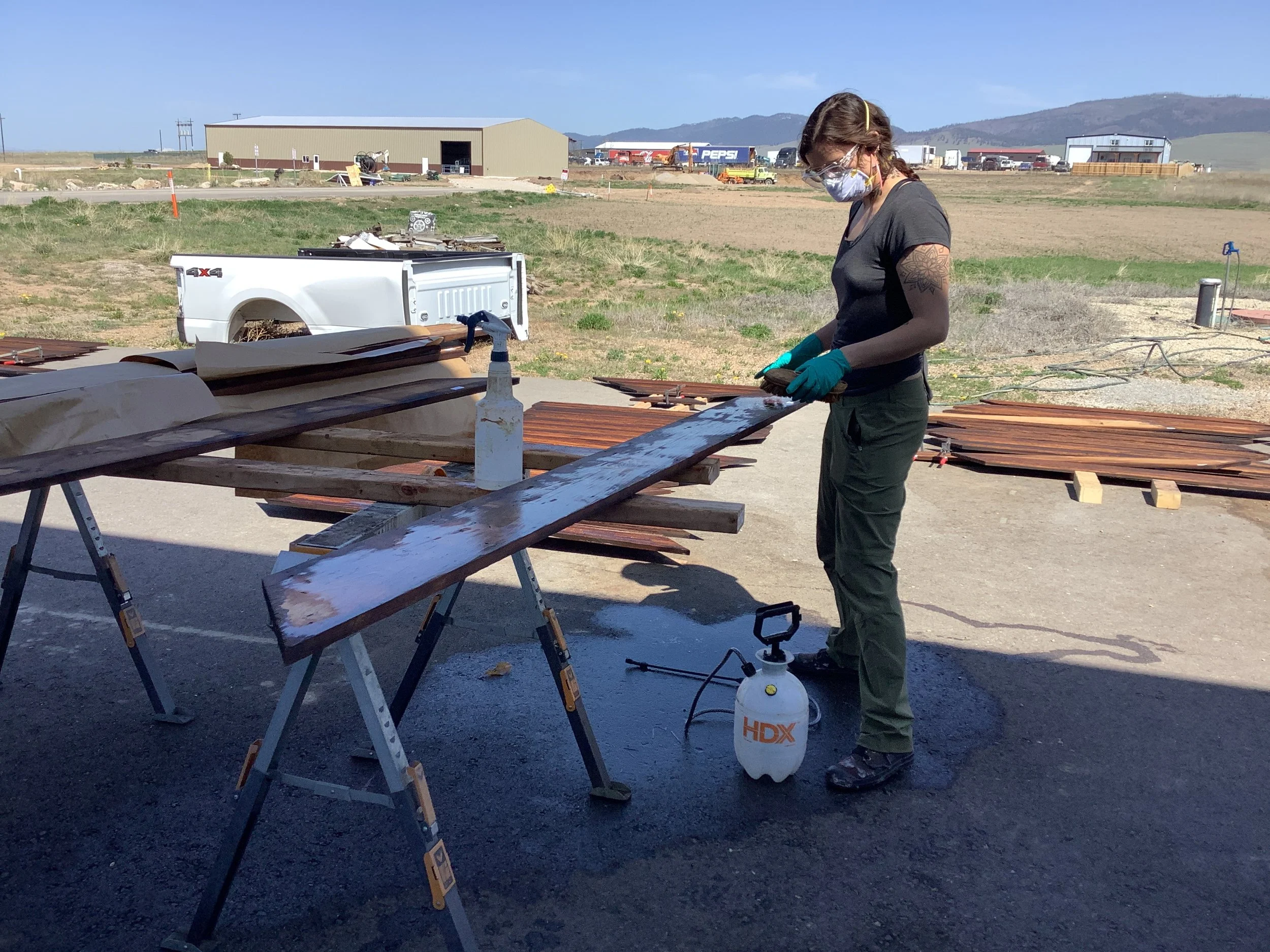
Josie applying the cleaning solution in Montana. Photo provided by Megan Randall
Where there any surprises for you or the team going into the project?
“No, I was pretty much coming from a learning-, I’d never done a conservation project like this or worked with conservators in general. So this was all a learning experience for me, but it was cool to learn all the research they had to do just to figure out the solution for what to clean it with. Because we didn’t want to like, strip the board completely or anything like that, or repaint them. Because that was part of George’s vision too. It was interesting to hear the science about it. I’m not a science brain I’m and artist brain, so it was cool to hear about that and the reasons why they chose that solution. So, it was all a learning experience.”
She goes on to explain that the process in Montana, although the entire phase took two weeks, they were only there for the first one. While there Josie was able to learn more about the cleaning solution used by MACC that would help to prevent mold without stripping the mural of the patina and natural color that was part of George Morrison’s vision for the artwork. Talking about how it looks all cleaned and in the new location Two Rivers Gallery curator Lydia Four Horns levels, “I’m a little sad its on the other side of the building, but its so beautiful now! It looks more bronze now and its so gorgeous.” Josie nods in agreement and adds, “The way the sun hits it, it’s just like ‘there it is!’”
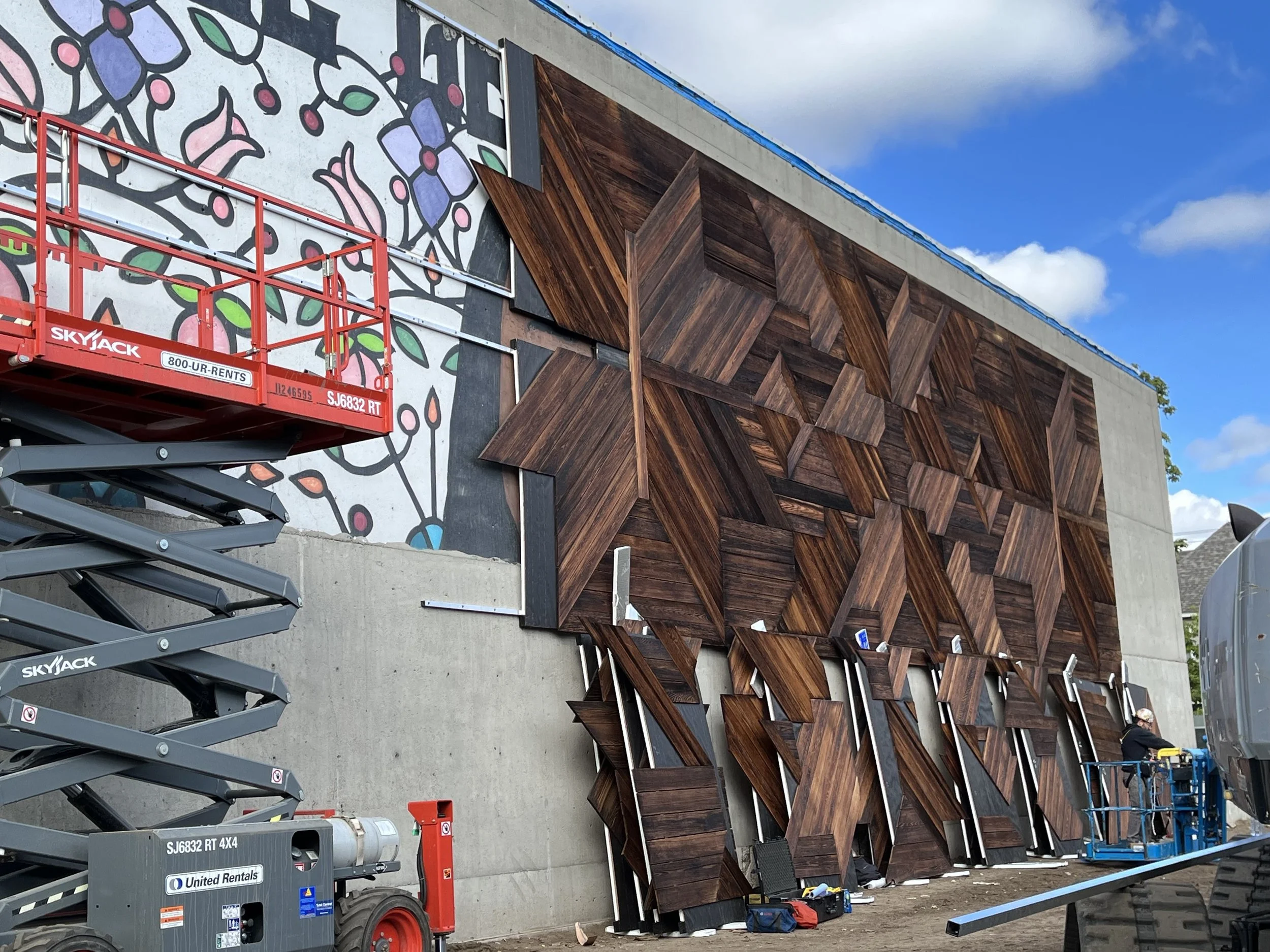
Re-installation of the mural panels. Photo provided by Megan Randall
Is this your first conservation project?
“It is, so it was like a really great learning opportunity. Like I said, I went to art school and I’ve just been interested in being in the arts and figuring out my career path. Right now I’m just like doing all these projects and I love it. Maybe that’s what I’ll just keep doing but I’m interested in caring for our community’s artwork. Like, I’m going down this curatorial path and I want to show off all these cool artists in our community. And so, it felt really special to be a part of the George Morrison piece on a personal level.”
Were you inspired by George?
“I’ve been inspired buy George’s work for a while, even before this project so it was exciting for me just to be able to work on this project. But, especially during my schooling, I would read about George all the time.”
Josie reminisces on the connection of her family to Morrison. “George Morrison was a mentor to my mom and my grandma knew him too; in their later years, my grandma and him were spending time together.” Originally from near the border of North Dakota in the twin town Breckenridge-Wahpeton, her maternal family is Grand Portage Ojibwe. "And then, I was asking my mom to tell me stories about when she studied under him. I was really fascinated.”
From an arts perspective, what were you thinking about [on this project]?
They immediately think back on the second phase of the project and all the wooden boards that make up the mural. “I loved cleaning them,” she states. “Cleaning the boards, because each individual board was beautiful in its own way. And I was like “this is just insane” like, being up close to it and seeing the fine detail of each board that is gonna be apart of something that’s so much bigger. That’s just one specific thing that I really enjoyed. My art side was just like ‘whoa’.”
Josie continues speaking on the people she was able to learn from and collaborate with, “It was cool working with the riggers too. And how they were thinking about putting this piece back together. Before they were all on the same backing, so what the riggers did was basically make these puzzle pieces for the backing so they kind of Tetris’d back in when we put them back up,” they explain. “It was really cool seeing their way of putting the pieces together and how they laid it out. Just watching the riggers do that was a cool learning experience. Just to see how they’re thinking about that too.”
What does it mean to you to work with other Natives on this project or other museum work you’ve done?
“I was happy to have other natives around. Being within institutions can often feel uncomfortable in ways, when its predominantly white folks running these institutions and the historical facts of these institutions; sometimes it can just feel uncomfortable as a native person, but like being with other natives and the art conservation center. And its really good to have these learning experiences too; within these institutions. I feel like I’m learning a lot with this work. It was nice to have other native around for support. And again, on that personal level, George being from my same tribal community and being able to care for this piece for him and for out tribe too, and for the community here in Minneapolis. ”
Lydia adds, “I think its just incredible that we were able to connect with someone who actually has some ancestral connection to the artist. I’m more than thrilled to be able to nurture that relationship more. When this project came up I thought that it was imperative that part of our work with MACC include training other native people that are new to the field or have an interest [in conservation].”
We continue to talk about the community around MAIC and what this project and artwork means to native people in Minneapolis and the greater-metro area.
Did you get a lot of community interaction while you were out there?
“When we were reinstalling, having community members come up to the fence and be like “what are you doing?” and being able to talk tot hem about that. So that was really fun.” She starts.
Two Rivers Gallery curatorial assistant, Sydney Ockenga joins in, “De-install was so fast. I remember seeing you out there and only a couple others watching. periodically then.” “And during that major [winter] storm too!" Lydia adds.
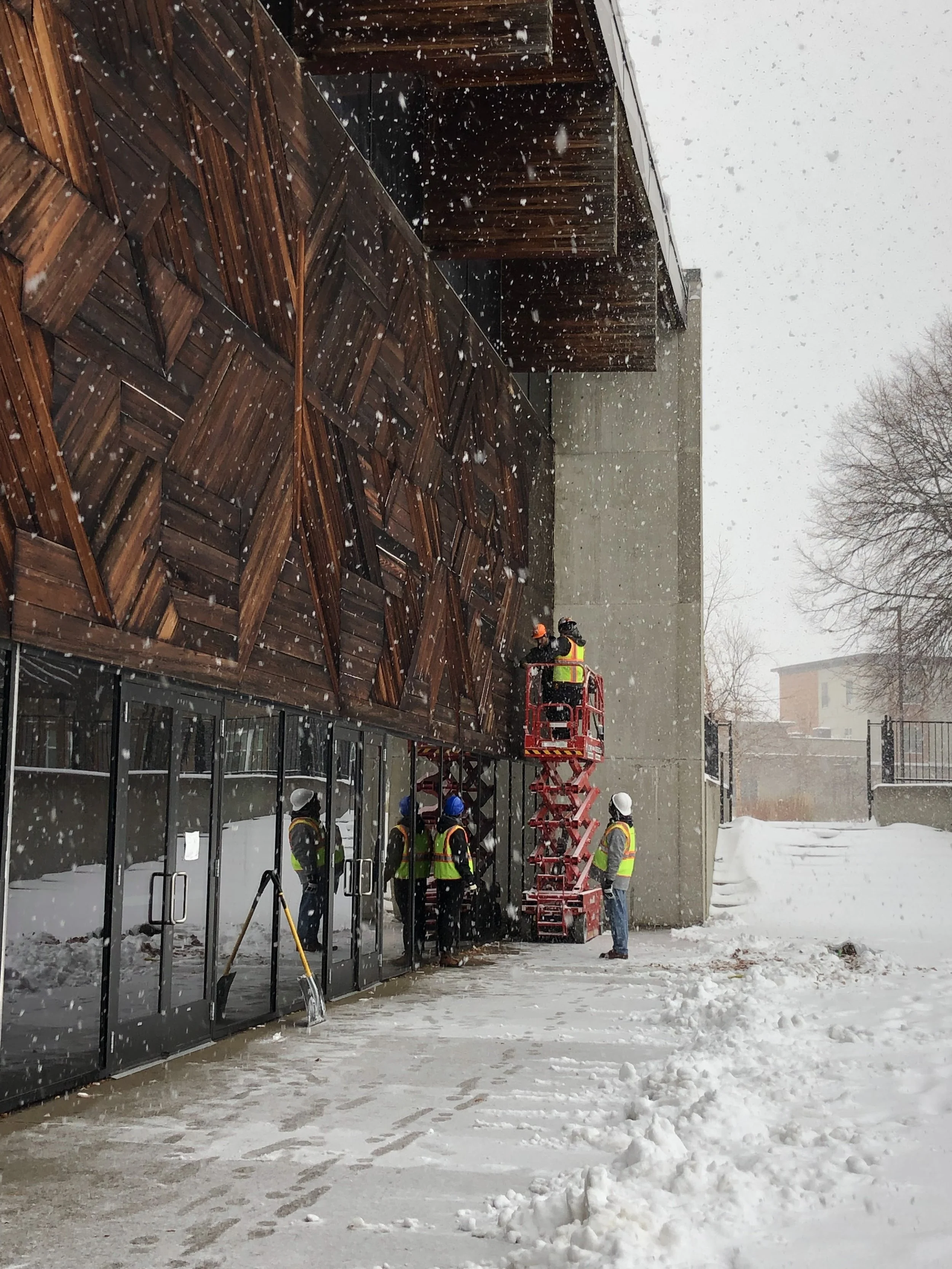
De-installation in winter. Photo provided by Megan Randall
Josie continues, “Yeah! I don’t remember a lot of community members coming around [then], but I think that was part because it was snowing and it came down so fast. Reinstall we had a lot time and people coming up to the fence and checking it out. That was a really fun part of the project too, just being able to see everyone.”
We thank Josie for their work on this project that is so important to the community and everyone else on the team that ensured the façade will be able to continue to be available all MAIC visitors. We look forward to her next projects and if you would like to follow what they do next you can visit their Instagram.